
 Depending on who you ask, service transformation can refer to a wide variety of processes:
- In the manufacturing sector, it describes the shift from being a product manufacturer to a service provider; this is where the concept of service first comes into play.
- In strategy consulting, it also tends to refer to the major cultural shift towards a customer-centric organisation. However, since AI has come to dominate the discourse, it is also often (too) simply used as a synonym for technological transformation, i.e. AI implementation.
- We, on the other hand, describe service transformation here in the customer service context as the process through which a service organisation develops further in a structural and sustainable manner.
This can mean, for example, moving away from reactive ‘firefighting’ mode and adopting a strategic approach. It can also mean that, following a fundamental assessment of the direction the journey should take, one first examines the technical setup and establishes it in a sensible and sustainable manner.
A good place to start in any case: clarifying the fundamental questions. How far along are you, actually? What role should customer service play within the company, and what should it achieve? And how can you tell that it’s working? Let’s get started.
 Customer service that stands still falls behind, which is why change is usually the rule rather than the exception. New channels and tools, new automation systems and, in particular, new AI applications are constantly reshaping processes and ways of working – and given the ever-increasing demands for accessibility, speed and service quality, this is hardly surprising. In this constant race, questions such as “Where are we actually heading?” or “Does it all actually fit together?” are quickly left by the wayside.
Incidentally, recent industry analyses also show that this pressure is continuing to mount. Gartner describes customer service as a sector that must constantly adapt to new technologies, changing customer expectations and growing complexity.
How do you further develop established service structures?
The lack of a strategic overview is particularly noticeable where processes are supposed to function across channels. Information is now scattered across multiple systems, responsibilities vary depending on the ticket type, and teams work in parallel using different workarounds because the setup and requirements have eventually drifted apart.
Service transformation is therefore important for most companies, if not vital to their survival. But although it is urgently needed, by no means everyone is looking beyond their own backyard and talking about it.
 Whether consciously or unconsciously, many service organisations are currently grappling with several transformation issues simultaneously, such as automation, AI, self-service options, reporting, knowledge management, omnichannel support and increasing demands for efficiency and customer experience. Internal processes are changing, new responsibilities are emerging and existing systems are having to take on tasks for which they were not designed.
The result: complexity is growing faster than structures in many teams. In customer service, this is particularly evident where parallel initiatives are running without a common framework – each one makes sense on its own, but together they are difficult to manage. Also Prosci and McKinsey have for years identified similar reasons why transformation projects stall:
- unclear priorities
- lack of direction
- too many parallel initiatives and
- responsibilities that are not clearly defined.
What they all have in common is a lack of clarity in the form of a customer service strategy, developed based on your goals and needs and backed by in-depth expertise at strategic, operational and technical levels. Without this, structures often emerge that (have to) function somehow from an operational perspective, but cannot be managed effectively or developed further.
The Peak Financial Group, for example, demonstrates how this can be done better. There, too, the system was continually expanded until over 400 automation processes were running in parallel, with conflicting rules and a lack of transparency leading to ever-increasing friction losses. It was only after processes, responsibilities and automation had been thoroughly analysed and restructured that a setup emerged once again that functioned efficiently, was transparent and remained manageable in the long term.
The first step
Where does your customer service stand today?
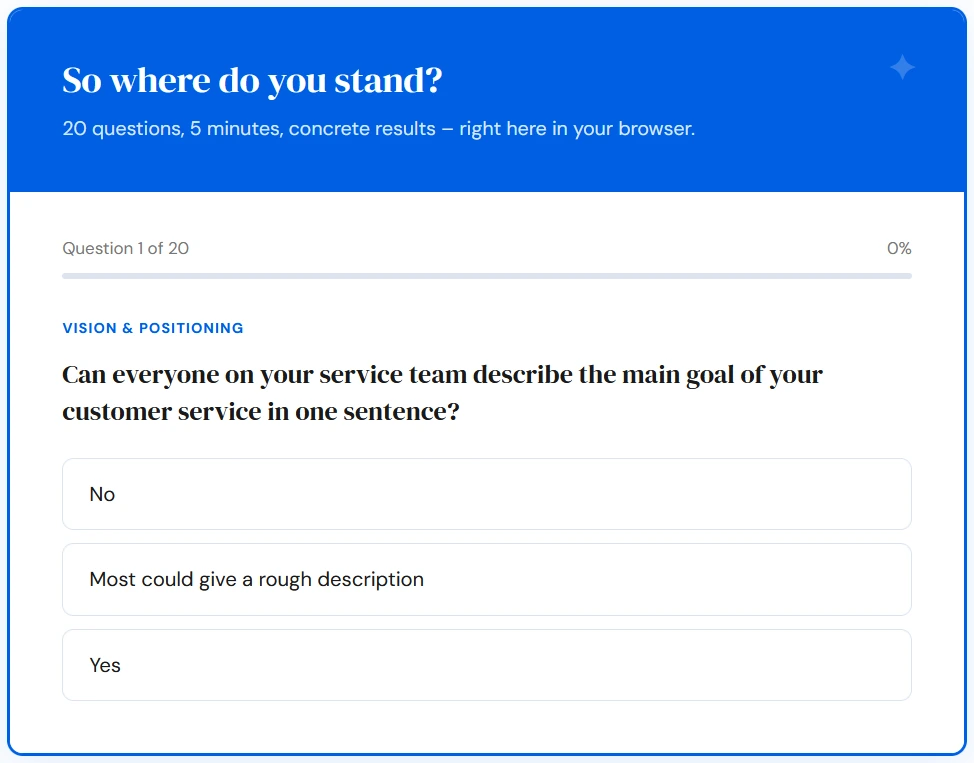
Transformation starts with clarity. Before deciding what should change, it helps to take an honest look at the current situation. Our maturity assessment gives you a first evaluation in just 20 questions.

AI is currently THE key driver of transformation in customer service. Given the (hoped-for) new opportunities, many companies are now more seriously than ever considering which tasks can be automated, how high ticket volumes can be better managed, and how the workload on teams can be reduced.
In doing so, they often turn their attention first to seemingly obvious AI applications such as chatbots or AI assistants for email replies – but (apart from standard enquiries) these are often also the areas where the weaknesses of artificial intelligence become particularly apparent.
AI can be used more effectively where it works with data based on very clear guidelines and takes over the tedious and repetitive tasks in the background: for example, when classifying tickets, prioritising and forwarding enquiries, summarising conversations, or structuring large amounts of disorganised information. However, this requires clean and structured data.
If you want to know whether this is the reason why the majority of AI projects in customer service fail, how much AI agents can actually take off your team’s hands, and if you’d like to delve deeper into the subject:
 Many service organisations know that change is needed. What often proves more difficult is determining how best to go about it, where to start, and which issues should be prioritised. In established setups, a needs assessment is essential – as this is the only way to identify which issues offer the greatest leverage and which measures should build on one another in a logical sequence:
- Which processes work reliably?
- Where do friction losses regularly occur?
- Which tasks are particularly time-consuming?
- Where do systems or structures hinder day-to-day work?
- And which changes actually contribute to the long-term goals of customer service?
To help you get started, we have developed a maturity assessment that gives you an immediate initial assessment of where your customer service currently stands and what the next sensible steps would be. Our article on Customer Retention Strategy shows how service can actively contribute to customer loyalty.
If you’re already certain that major changes are unavoidable and want to start with a comprehensive diagnosis, we highly recommend the Customer Service Clarity Workshop! Two of our experts will ask you questions in advance, visit your premises for a day, and then analyse the results with you, including a roadmap.


⭐⭐⭐⭐⭐
Diana ZimmermannAnnanow Group AG

⭐⭐⭐⭐⭐
Philipp SchumacherIntravis GmbH

⭐⭐⭐⭐⭐
Gerome KörbelYuma GmbH

⭐⭐⭐⭐⭐
Jürgen Königeh. Häfele SE & Co KG

⭐⭐⭐⭐⭐
Susanne HeizHead of Service at JobCloud AG