By implementing dynamic signatures in Zendesk you can save time and keep your email formatting consistent across teams, while adding personal touch based on contextual information.
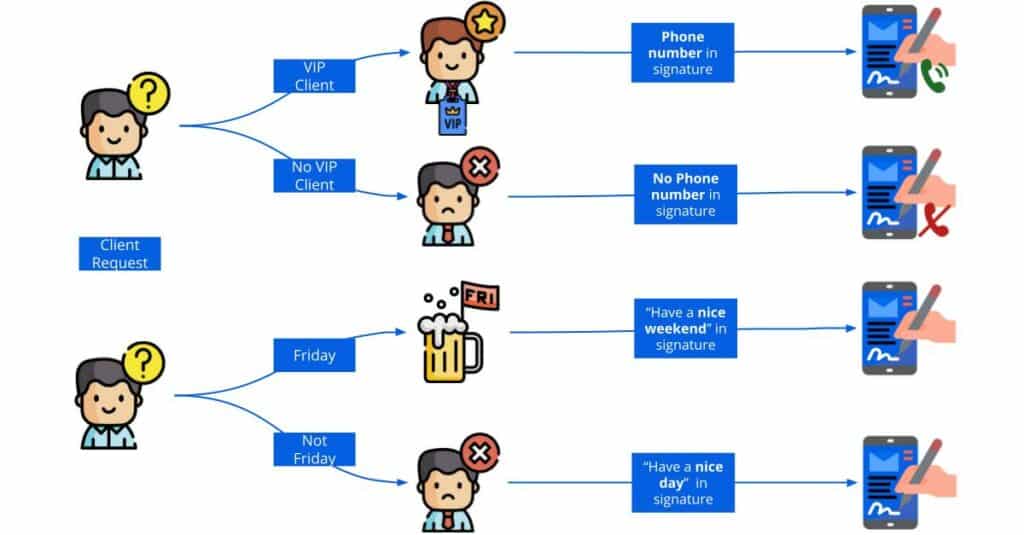
For example: include your company phone number only for VIP clients, or change the greeting depending on the day of the week.
- Your goal
- Usage examples
- Group-related signatures – Example
- Group-related signatures – Possible solution
- Multiple groups without fallback
- Your benefits
Your goal
Your goal is to set up dynamic signatures in Zendesk, which should change based on ticket information. Agent data, ticket data such as group, brand, form, status or custom fields, and requester or organization data such as VIP status or customer segment are possible data sources that can trigger different signature variants.
Automatic signatures will result in less manual work, and consistent, yet personalised emails which are signed differently depending on the defined criteria.
Usage examples
- Different phone numbers in the signature based on ticket form or ticket group. Invoice-related questions should go to the accounting team, while other questions should go to the support team.
- VIP clients see a phone number, while regular clients don’t.
- If the customer belongs to a high-value segment, include a personal email address. Otherwise, include the general support email address.
- If weekday = Friday, wish the client a nice weekend.
- If the client is subscribed to the newsletter, include a link to news on your blog.
Group-related signatures – Example
Let’s say you have multiple groups in your Zendesk account, and each one should have a different email address and phone number. With standard agent signatures, the personal signature itself is managed by the agent, but the logic for different signature variants usually needs to be handled in email notifications, macros or dynamic content.
By dynamic signatures, we mean that the information shown changes depending on ticket information such as ticket group, brand, status or a custom ticket field. “If this condition, then use this signature.” To make this possible, we’ll use placeholders and Liquid markup to add logic to the signature.
Group-related signatures – Possible solution
Multiple groups without fallback
- Define which Zendesk groups require which signatures.
- Identify the group IDs.
- In Zendesk Admin Center, go to People, then open Team or Groups, depending on your account interface. Open the group and check the ID in the URL.
- Make an API call to download all groups and their IDs.
- Create dynamic content in Zendesk Admin Center under Workspaces > Agent tools > Dynamic Content.
{% if ticket.group.id == 360004007151 %}
sales@123business.com
{% elsif ticket.group.id == 360005404920 %}
support@123business.com
{% elsif ticket.group.id == 360005438040 %}
press@123business.com
{% else %}
support@123business.com
{% endif %}- Save the placeholder in dynamic content, for example as {{dc.signature_email}}.
- Copy and paste your Liquid markup in a new dynamic content item and edit the conditions, now for your phone numbers based on the group. Save the placeholder, for example as {{dc.signature_phone}}.
- Create a macro with the placeholders to sign your messages dynamically with just one click, or add the placeholders to the relevant email notification setup if the signature should be added automatically.
Warm regards,
{{current_user.name}}

{{dc.signature_email}}
{{dc.signature_phone}}
How this could render:
Warm regards,
Fred Parker
support@123business.com
+49 1234567890
Placeholders such as ticket.group.id, ticket.brand.name and others can be used with Liquid markup to create signatures based on specific conditions. See Zendesk’s placeholder reference for business rules. If you have a custom ticket field, for example an internal status, this can also be used in Liquid markup. See Zendesk’s article about using placeholders for more information on custom fields.
If you’d like to read more about Liquid markup, check out Zendesk’s article on Liquid markup in Zendesk Support or the official Liquid documentation.
This is a simple way to personalise your messages and ensure your team is also consistent in the way they sign emails with Zendesk. Including a logo in the signature or adding more information is possible with agent signatures, branded signatures, macros, dynamic content, or by adjusting the HTML email template in Zendesk. If you have any questions or comments, please let us know and we’ll be happy to help.
Your benefits
- Less clicks save you and your team time.
- Personalised email signatures.
- Consistent email styling.