How can you connect Zendesk to an SAP on-premises installation? A Zendesk SAP integration can provide data from different SAP systems, including CRM, ERP and HR. The right approach depends on your existing infrastructure.
Your goal: customer information directly in Zendesk
Your service team needs quick access to customer information and data from the backend. This could include customer records and orders from SAP ERP, or tasks, contact histories and sales opportunities from SAP CRM.
Ideally, your team can find this information in Zendesk without searching in additional tools.
Connecting Zendesk and SAP with a custom app
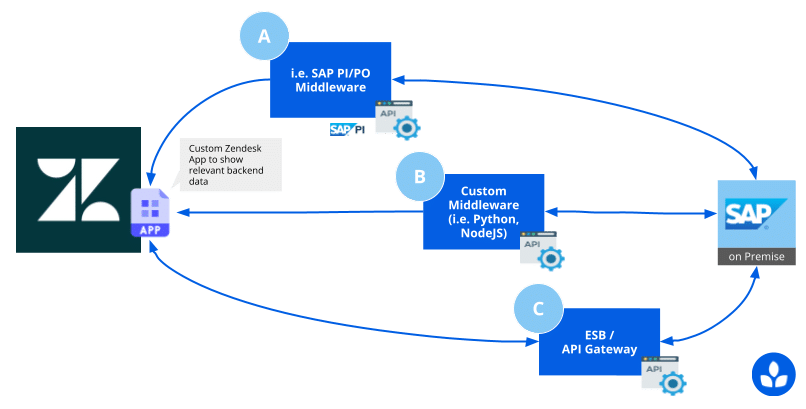
A common approach is to build a custom Zendesk app that displays the data from your SAP or backend system.
Middleware on the SAP side
Middleware or an API makes SAP data available to other systems. It retrieves the data from the backend when needed and provides it through an API or REST interface.
- SAP middleware: Solutions such as SAP PI (CPI) or SAP PO (CPO) provide the data that Zendesk then retrieves.
- SAP SOAP interface: Ideally, the SOAP interface is already accessible from the web. Alternatively, a proxy in a cloud environment can connect to the corporate network through a VPN. The setup depends on where your systems are hosted.
- Custom middleware: You can also use middleware developed for your requirements. Libraries such as PyRFC for Python or node-rfc for Node.js connect to SAP through RFC and provide REST/JSON to the Zendesk app.
- ESB or API gateway: If your company already uses an API layer or enterprise service bus, the Zendesk app can communicate with it to display the relevant data for your agents.
Alternative approaches
BI database or data warehouse
If SAP PI or other middleware is not available, we check whether the required information already exists in a BI database or data warehouse such as DWH/BW. These systems can also serve as a source of SAP data for Zendesk.
SAP S/4HANA REST interfaces
If you already use SAP S/4HANA, its REST interfaces may offer a straightforward connection, depending on your setup.
Exporting and importing files
Exporting data from SAP as a flat file is theoretically possible, but we do not recommend it. File formats, UTF-8 and Unicode encoding, date formats, decimal separators, time differences and empty files can all cause problems. Reimporting data into Zendesk is also unsuitable for some objects, such as orders and line items.
For flat-file scenarios, we recommend importing the data into a dedicated database with a separate API.
API endpoints for SAP middleware
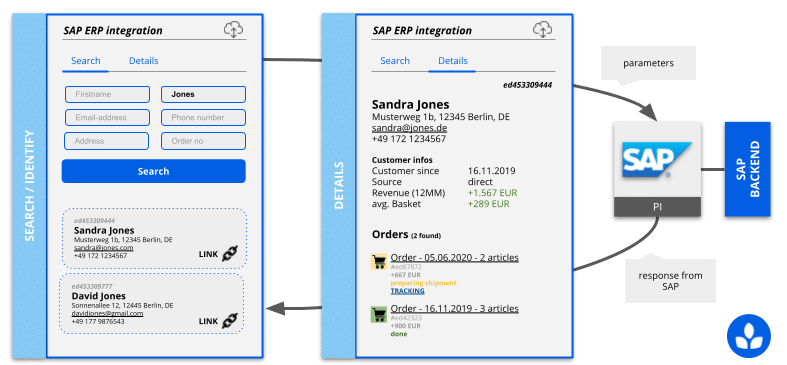
Your Zendesk SAP integration needs suitable API or middleware endpoints. An ERP connection might use the following:
- searchCustomer: searches for customer information such as customer number, name or address and returns a list of matching customers with their header information.
- getCustomerDetails: retrieves details using a customer number or another unique identifier. This can include customer records, address and contact information, and indicators such as sales over the last twelve months or customer lifetime value.
- getOrders: returns a customer’s orders, including details such as order value, date, products and status. Tracking information from logistics providers may also be useful, if available.
What your team gains from a Zendesk SAP integration
- frequently needed customer information directly in Zendesk, making day-to-day work easier for your service team
- fewer switches between systems and less time spent searching
- faster answers for customers, which can improve customer satisfaction
- direct links from a ticket to the SAP interface
- potentially less load on SAP, depending on the implementation