1. Know where you're starting from
To plan a route, you need a starting point as much as a destination – without knowing where you are, you can't meaningfully take the next steps.
Customer service decision-makers face exactly this challenge: without knowing where your service organisation stands today and where it needs to go, you can't act with purpose. Who are you (and how many of you are there), what do you need in the short term, and what do you need to kick off today to be well positioned for the long haul? The maturity model is part of a broader strategic framework – our customer service strategy page covers what comes after the stocktake.
Our maturity check is the first step towards greater clarity. In just 5 minutes, you'll know not only which stage you're at, but also how to get to your goal as directly as possible.
What a service maturity model does
When it comes to developing service organisations, patterns and parallels emerge regardless of industry or company size – from initial reactive problem-solving through structured optimisation to strategic alignment. We explain the differences, provide orientation, and show which challenges are typical for each stage of development.
This is more than just a look in the mirror (and advice to visit the barber): especially when leadership, the service team, and other departments have no clear or differing views of where your service stands today, a maturity model also creates a basis for discussion.
Want to go deeper on what strategic customer service actually looks like? Our strategy guide covers the full picture.
Customer service strategy guideThe three maturity levels
Reactive – thrown in at the deep end
Reactive service organisations are often only recently confronted with challenges like a significantly grown customer base – or have settled into this stage for too long. Any day can bring surprises, and problems are met spontaneously and creatively. Resources are usually tight and consumed by daily tasks; the team is essentially working nonstop on urgent to-dos to stop ticket numbers, wait times, and complaints from climbing even further.
- The team is frequently overwhelmed.
- New agents or new tools often only help in the short term.
- KPIs are limited to efficient ticket processing.
- Service operates largely in isolation, with no systematic feedback between departments.
Improving – when the common thread is missing
You've started thinking about support more systematically: processes are being reviewed, improved and documented, your tools work, and the team is receiving targeted training. The various optimisations are running in parallel, but they're not reinforcing each other. You've made clear improvements in individual areas, but it mostly remains piecemeal:
- Self-service exists in places, but isn't being used well.
- Integrations still leave your team transferring a lot of data manually.
- Automations are running, but only at a small scale.
- Collaboration with product or sales isn't systematic.
- You have goals, but no long-term masterplan.
Good to know: What strategic efficiency looks like beyond isolated optimisations is covered in our article on service efficiency strategy.
Strategic – the framework is taking shape, execution is underway
You're at a point where you can think about service strategically, and you know what role support should play in the company. Decisions are increasingly guided by whether they align with these goals, and you're thinking of customer service more and more as a lever for retention and growth. Alongside operational metrics, you're giving more attention to strategic KPIs like retention rate or customer lifetime value. Congratulations!
That said, even here the journey continues:
- Without external expertise on new AI tools, you lack a solid basis for deciding what you actually need.
- The alignment between vision and feasibility is missing: what's actually achievable and worthwhile?
- You're not sure which further options are still open to you.
- You'd welcome an experienced sparring partner to stress-test your strategy.
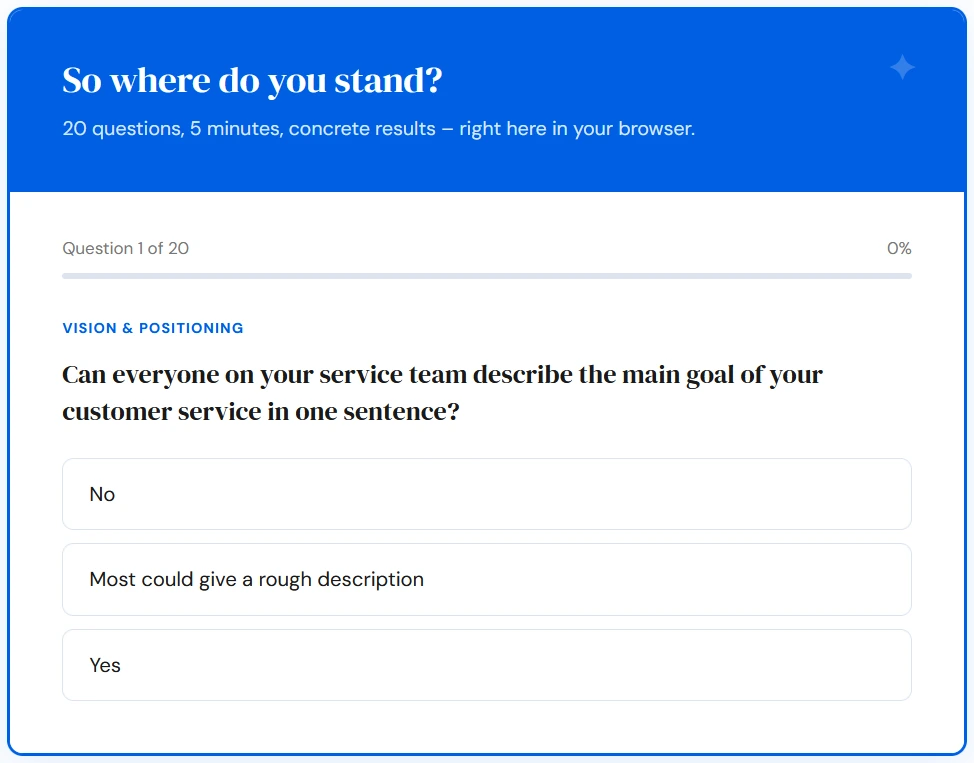
So where do you stand?
20 questions, 5 minutes, concrete results – right here in your browser.
6 dimensions for taking stock
The maturity check shows where you currently stand – it covers six areas that provide the most insight:
- Vision & Positioning: Is it clear what role service plays in the company?
- Goals & Governance: Are you tracking the right KPIs?
- Planning & Roadmap: Is there a common thread for the next 6–12 months?
- Organisation & Change: Does service collaborate with other departments?
- Customer Retention & Engagement: Are you working reactively or proactively?
- Technology & Scaling: Can your tools keep pace with growth?
Alongside an overall assessment, you'll also receive a brief overview of your maturity level in each of the six categories.
Ready for the next step?
The check shows in just a few minutes where your service stands and which areas offer the biggest levers. You'll see which stage you're currently operating at and which typical patterns come with it. The results break down your answers across the six dimensions – making visible where you're consistently well set up and where tensions are emerging.
You'll also get concrete recommendations tailored to your situation: which topic should you explore further, and which step makes sense next?
Our Clarity Workshop shines an even brighter light on things: after a few questions in advance, two of our customer service experts come to you for a day – with a very powerful torch – and examine your setup from top to bottom. The outcome is a concrete, directly actionable roadmap for the next 12 months: with quick wins that give the team momentum, and long-term projects that strengthen you structurally.
More about the Clarity Workshop