⚡BREAK THE CYCLE

Customer service strategy: From cost center to growth driver

Thinking strategically about customer service instead of just acting ad hoc has been proven* to make a difference to a company’s success.

We help you find the common thread and position yourself sensibly in both the short and long term with the right customer service strategy – and then we implement it together with you: from analysis and implementation to long-term support.

The result: your service will transform from a reactive cost factor to a strategic growth lever.

* Strategy makes the difference:

The problem: You're optimizing yourself into a corner

Most service teams work without a strategic framework. Many continuously optimise – new tools, better processes, more training – but without a clear idea of where all this should lead. The result:

📨
Growth Without Impact

The service team grows by 30%, revenue by only 12%. New ticketing system, documented processes, trained agents – and customer satisfaction still doesn't move. Why?

🤖
Tools Without Direction

An AI tool enters the company because the demo was convincing. Three months later, half the team is ignoring the new features in frustration. The other half is still wondering what problem the tool was actually supposed to solve.

Questions Without Clear Answers

Asked whether customer service contributes to company growth, you can't back up the "yes." Not necessarily because your contribution is too small, but because you can't trace it – and don't know what to change.

Individual measures are of little use if they do not contribute to the bigger picture. Teams are constantly putting out fires and forced to react instead of being able to plan ahead sensibly, structural errors keep cropping up, and at some point it becomes clear: there is no way forward in this hamster wheel. The result: your team is exhausted, the figures give cause for concern, and disappointed customers switch to the competition.


Customer service tactics vs. strategy: what exactly is the difference?

Acting tactically solves specific problems in the here and now. Thinking strategically asks where your customer service should be in two years’ time and what decisions need to be made today to get there. The difference determines whether you spend your time putting out fires or making sustainable progress in the long term.

Area Tactical Strategic
Hiring Hire two new agents because wait times are getting too long. Develop a scaling model that defines when and how the team grows – and what automation needs to kick in beforehand so that growth doesn't scale linearly.
Tools Buy an AI tool because it solves a task faster than a human. First define which use cases should actually be automated, then find the solution that fits. Also define success criteria upfront.
Processes Expand the FAQ because the same questions keep coming in. Develop a comprehensive self-service strategy that defines which requests should be resolvable without human interaction – and how customers get there.
KPIs Reduce response time because it keeps creeping up. Ask which metrics actually show whether service is working: retention rate, customer lifetime value, repurchase rate? Then build on those.

Solving problems tactically in the short term often brings quick improvements, while making strategic decisions creates long-term effects. The challenge lies in combining the two in a meaningful way.

🧭 AI: no end in sight

AI in customer service: between hype and added value

💡Industry surveys estimate that approximately 67% to 80% of all AI projects fail – either before they become productive or without realising any added value.

AI continues to be THE hot topic in customer service – and there is a great deal of uncertainty because most companies lack the internal expertise to know what will really benefit them. However, this does not seem to deter most teams (see above).

To gain an overview of what suits your needs, what you can implement and how, and to be able to distinguish between marketing promises and actual added value, we strongly recommend a partner who will remain at your side in the long term and who knows AI in customer service at all levels:

Developers building, testing and deploying chatbots on platforms. Chatbot platform, virtual assistant development, cross-platform chatbot concept. Bright vibrant violet vector isolated illustration
🔧

Technical

Which tools fit your infrastructure? How do they integrate with existing systems? What does that mean for data protection and compliance?

⚙️

Operational

Which processes are suited for automation? How does your agents' work change? What quality assurance does AI-assisted service require?

🧭

Strategic

How does your service position itself within the company? What role does AI play in that vision? Which KPIs show whether AI actually creates value?

The result: AI solutions that actually meet your requirements and whose implementation is supported in the long term – from the initial analysis to ongoing operation.

What does a customer service strategy involve?

A customer service strategy provides guidance for your support team – a common thread that ensures decisions build on each other rather than contradicting each other – so that hiring, KPIs, processes, tools and the organisation all work towards the same goal.

This includes the following six areas:

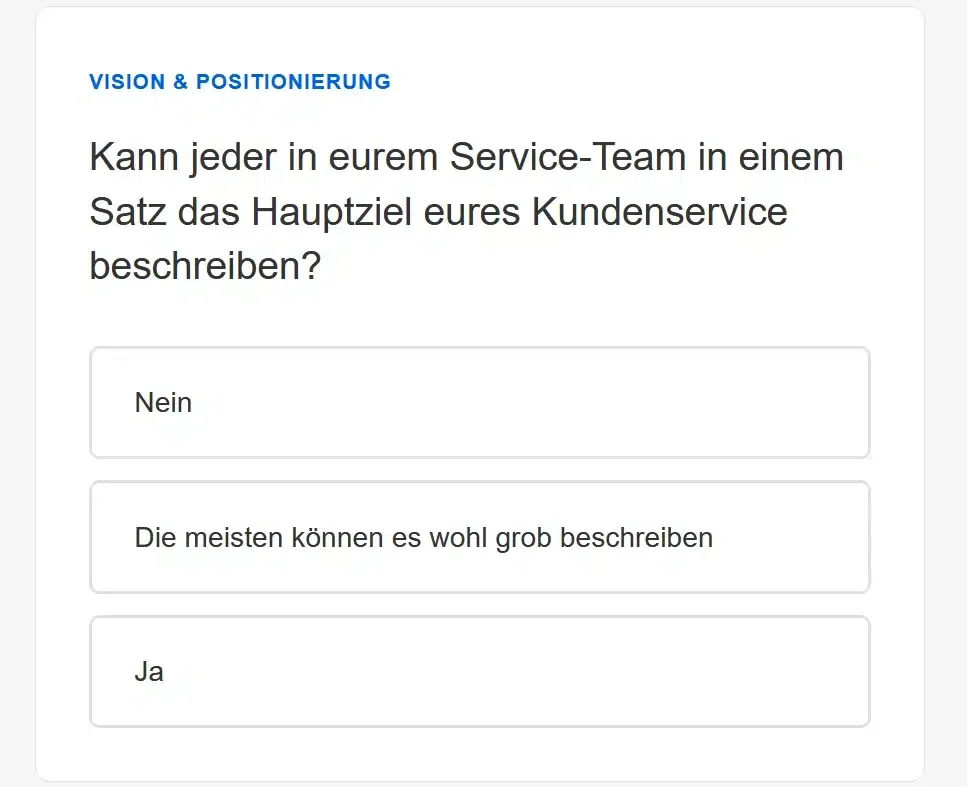
1. Vision & positioning

Where do you stand and what should your service achieve?

Does your service function as a cost centre that processes tickets as efficiently as possible? As a growth lever that actively contributes to customer loyalty? Or as a differentiator that clearly sets you apart from the competition through premium service and expertise? The answer determines almost everything else: budget, team size, degree of automation, SLA level and tool stack.

Anything can be right for you; there is no one-size-fits-all approach. It becomes problematic when you don’t know where you stand and where you want to go, zigzagging from one point to another without seeing that you’re running out of fuel or that the oil lamp is lit. A clear orientation gives the team direction and makes decisions comprehensible, from agent training to tool selection.

Kundenservice-Strategie entwickeln

2. Goals & Control

How can you tell that your service is working?

The question sounds simple, but the answer is often difficult: Support teams typically measure response time, first contact resolution and CSAT – necessary metrics, but not sufficient from a strategic perspective.

Strategic KPIs show the impact

Do customers stay with the company? Do they buy more? Do they recommend you? And do they experience your service as a real quality factor? These questions lead to key figures that count for the success of the company:

  • Retention rate: How many customers remain after the first year?
  • Customer lifetime value: How much revenue does a customer generate over their entire customer relationship?
  • Net Promoter Score: How many customers would actively recommend you?
  • Escalation Rate: How many enquiries escalate to Tier 2 or 3?
  • Time-to-Resolution for complex cases: How long do the really difficult cases take?
  • Feedback quality from high-value customers: Is service perceived as a premium experience or just a problem solver?

Not every organisation needs all of these metrics. But every organisation needs clarity about the impact its service should have and which metrics reflect that.

🔍 A real-world example

A SaaS company tracks how many customers upgrade their subscription after contacting support – a clear indicator that service creates value. Customers understand the product better, use it more, and are willing to pay more for it.

That's not a coincidence, but the result of a deliberate decision: to run service not as a cost center, but as a growth lever.

The Customer Service Clarity Workshop: One day, real results

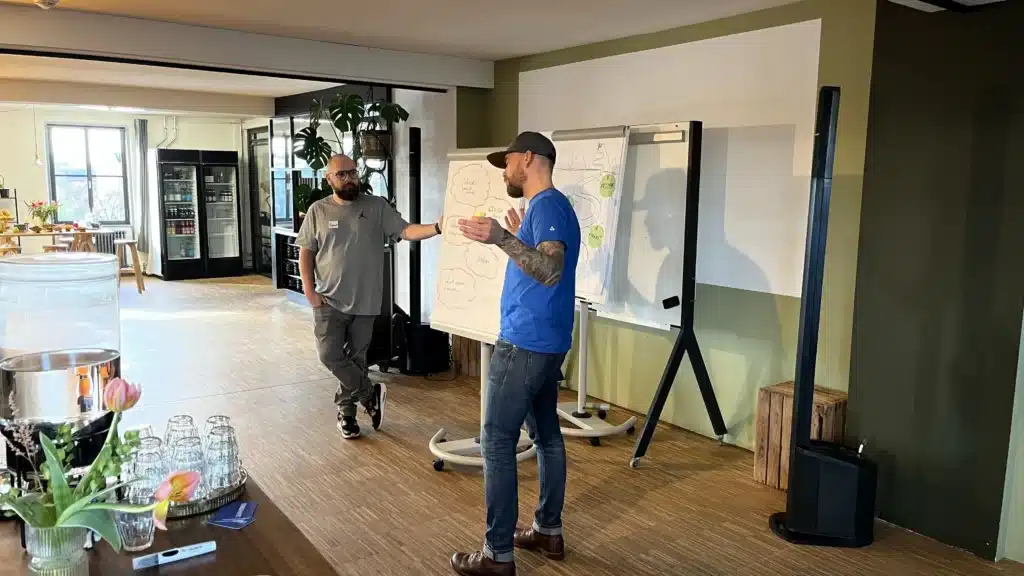
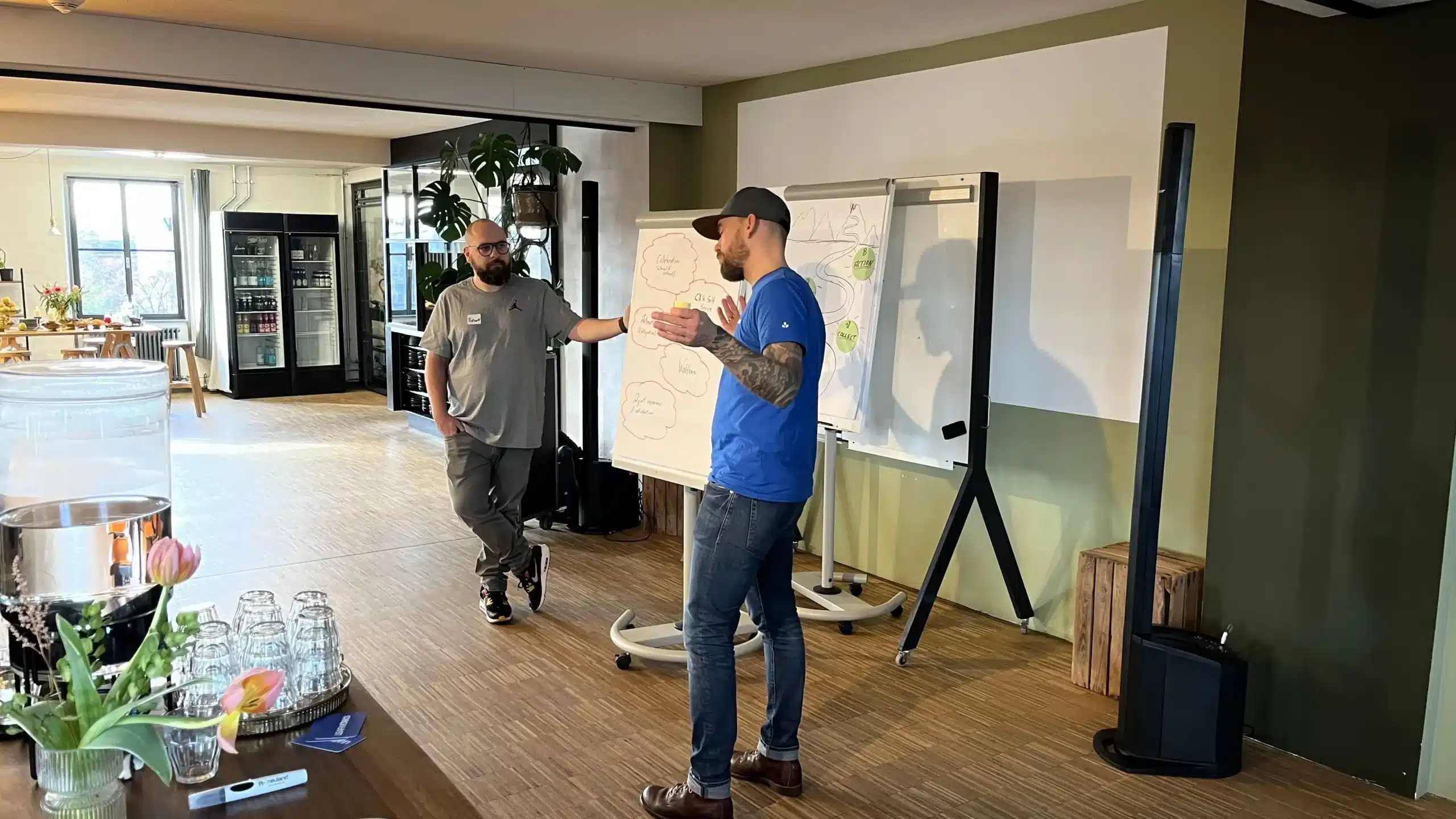
KLarheit im Kundenservice: Eindruck vom Leafworks-Workshop

Strategy often means long planning phases, endless discussions and documents that remain in the filing cabinet. Our customer service experts, on the other hand, are just as skilled in theory as they are in practice and will examine your support system in a very targeted manner.

What you get:

  • Clarity: Objective evaluation of your service setup from an outside perspective
  • Quick wins: Immediately implementable improvements that give you momentum
  • Roadmap: Prioritisation for the next 6 months that will actually be used
  • Confidence in action: Clear next steps towards your strategy

We look at where you stand, identify the biggest levers and develop a concrete plan. We are then happy to implement this plan with you, from tool selection and automation to ongoing checks and fine-tuning.

3. Planning & Roadmap

What will happen in the next 6–12 months – and why?

A service roadmap combines short-term relief with long-term structural development. It answers three questions:

  • What do we tackle first? Which quick wins deliver immediate results and give the team momentum?
  • What do we build? Which strategic projects take time but pay off in the long term?
  • What do we deliberately leave out? Which ideas may sound good, but don’t fit with our vision and priorities right now?

Example: Reducing escalations

🔍

Starting Point

Many tickets end up with Tier 2 or specialists.
The result: long resolution times, frustrated teams and customers, high costs.

Quick Wins

  • Analyze the top 5 escalation reasons: why do cases get escalated?
  • Create standard responses and internal decision trees for them
  • Train the Tier 1 team specifically on these cases
→ Effect: Fewer escalations and faster resolutions right away.
🏗️

Long-Term Levers

  • Establish clear support triage: which topics actually belong to Tier 2?
  • Introduce skill-based routing
  • Professionalize knowledge management: articles into the help center and the support playbook
→ Effect: The system becomes more stable.

What We Leave Out

  • No new AI tool needed before routing and roles are sorted
  • No additional agents needed
  • No expansion to new channels until existing support scales cleanly
→ Effect: Focus over actionism.

4. Change & Transformation

Does your structure match your reality?

When marketing, sales, product and service departments work in silos, customers feel the friction: they are passed around, receive contradictory answers and have to repeat themselves. Better processes can mitigate such problems, but they cannot eliminate them.

Examples of when structural changes are necessary:

  • AI and self-service now handle 70% of standard enquiries – only complex cases end up with the team. This fundamentally changes the work and requires different skills, different processes, perhaps a different setup of in-house support, BPO and AI
  • Product feedback gets lost in the ticket system because the service team has no direct connection to development. Process optimisation here would be better ticket tagging and weekly reports.
    Structural change: Create a product support role that works directly with the product owners.

Strategic questions:

  • Where is important feedback getting lost today?
  • Which roles are missing (automation owner, product support)?
  • Which combination of in-house, BPO and AI fits your long-term requirements for good customer service?
  • And how do you ensure that the team has a say in relevant decisions – instead of just dealing with the consequences?
How mature is your service? Check now!

The first step: honesty

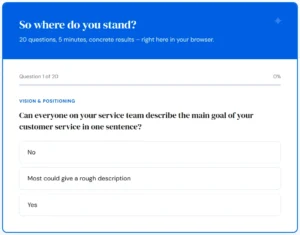
Before you look to the future, take a clear look at the status quo. Our maturity check shows you where your service stands today in just five minutes. Twenty questions classify your service across six dimensions:

  1. Vision & positioning: Do you know what your service stands for?
  2. Goals & control: Are you measuring the right things?
  3. Planning & roadmap: Are you following a common thread?
  4. Organisation & Change: Is the team set up correctly?
  5. Customer loyalty: Does service contribute to retention?
  6. Technology: Are the tools suited to the requirements?

At the end, you will not only receive an immediate assessment of the current status, but also specific recommendations for action for the next steps.

You can find more background information on the evaluation and the results in our detailed article on the service maturity model.

5. Proactive support strategies & customer loyalty

Service – more than just support?

If customers only contact customer service when something goes wrong, a lot of potential remains untapped, because service can only contribute reactively to customer loyalty. Proactive service goes beyond problem solving and reaches out to customers before they become dissatisfied.

Strategic approaches can include:

  • Health scoring and churn prevention mechanisms
  • Systematic onboarding check-ins
  • Usage monitoring with targeted activation
  • Regular reviews with B2B customers
Also important: The earlier critical signals are detected, the lower the costs per customer saved.
Kundenportal personalisieren

6. Technology & scaling

Which systems do you need – and in what order?

Sure, new gadgets are fun, but when deciding on tools, the question must be: What do you want to achieve with them? Tools should support your support processes, relieve the team and fit your actual requirements. Depending on your strategic orientation, this means maximum efficiency, targeted growth support or deliberately high service quality.

A strategic view distinguishes between three levels:

1. Automation Level

  • What stays deliberately human?
  • Which standard requests get fully automated?
  • Where does AI provide partial support?

Recent studies show: up to 80% of routine requests can be automated. The key is classification: routine can be automated, while complex or quality-critical issues stay deliberately with humans.

2. Data Quality

AI and automation only work with clean data:

  • clear ticket categorization
  • structured fields
  • clean process definitions
  • traceable escalation paths

Without a solid data foundation, technology remains a cost driver.

3. Make-or-Buy & Tool Stack

  • Is the native ticketing system sufficient?
  • Are specialized automation or routing solutions needed?
  • When is BPO more cost-effective than in-house growth?
  • Which systems need to be integrated to ensure no context is lost?
Sensible use of technology makes all the difference: 83% of CX leaders who use generative AI report a positive ROI.

Grow profitably instead of burning through your margins

If service costs rise faster than revenue, you will lose money even as you grow. Even a service team that grows linearly with your customer base will eventually become unaffordable.

The right setup and technology ensure that you don’t necessarily need more agents for more customers without compromising quality or driving your team to burnout.


Our preferred technology partners include Zendesk, HubSpot, Aircall and monday.com – tools that we not only recommend, but also implement and use ourselves! All technology partners at a glance

Strategy + Implementation: What sets Leafworks apart

Most consultants provide you with a strategy paper and then keep their fingers crossed for you from afar. However, we not only develop a strategy with you that takes your customer service to a new level, but also implement it with you:

From tool selection to process optimisation and automation to regular checks and fine-tuning. If you wish, we are also happy to work with you on a long-term basis as a strategic partner that grows with you.

We can do this because we are masters of both strategic thinking and technical implementation. After nearly 1,000 customer projects, we know exactly how to tackle challenges in a way that not only delivers convincing results, but also inspires enthusiasm.

What our customers say

Let us discuss your customer service

I will help you escape the operational hamster wheel and strategically position your service so that it not only processes tickets but also contributes measurably to your company’s success. Together, we will clarify where you stand today, which goals really matter, and which decisions will move you forward in the next 6 to 12 months.

If you want to transform your customer service from a reactive cost factor into a clearly positioned strategic lever, let’s talk.

Robert Cwicinski, Kundenservice + CX-Experte bei Leafworks

Robert Cwicinski

Customer service expert

FAQs about customer service strategy

A customer service strategy is a decision-making framework that defines the role of service within the company, the goals that matter and the levers that take priority. It ensures that processes, tools, organisation and KPIs all work towards the same goal – rather than hindering each other.

Because otherwise, support usually only reacts: more tickets, more tools, more effort – but no long-term effect. A strategy creates clarity about which requests are automated, where personal service is crucial, and how service measurably contributes to the company’s success.

Typically six core areas:

  • Vision & positioning
  • Goals & control (KPIs)
  • Planning & roadmap
  • Organisation & Change
  • Proactive Customer Loyalty
  • Technology & Scaling

Not as a rigid model, but as a structure to ensure that decisions fit together.

Optimisation improves individual measures in the here and now (e.g. expanding FAQs, reducing response times). Strategy determines where the service should be in 1–2 years – and which measures should be prioritised today to achieve this. (Link: Tactics vs. strategy in customer service)

In addition to operational key figures, the following are particularly important from a strategic perspective:

  • Retention rate
  • Customer lifetime value
  • Escalation rate
  • Time to resolution for complex cases
  • Net Promoter Score (NPS)

What matters is not the number of KPIs, but whether they reflect the desired effect.

At the latest when one of the following applies:

  • The team is growing, but customer satisfaction is not
  • New tools are not bringing about any clear improvement
  • Escalations and complexity are increasing
  • Automation is being introduced, but without a plan
  • Service should contribute more to customer loyalty

No. Strategic service means making conscious decisions:

  • What remains human because it builds trust?
  • What is automated because it is routine?
  • Where does AI only provide partial support?

Automation without clarity often leads to chaos instead of relief. Learn more about AI in customer service

A central one. AI and automation only work with clean foundations:

  • clear ticket categorisation
  • structured fields
  • defined processes
  • traceable escalation paths

Without a database, technology quickly becomes a cost driver.

A good roadmap combines quick wins with long-term structural development:

  • What provides immediate relief?
  • What contributes to the vision and KPIs in the long term?
  • What do we deliberately leave out in order to stay focused?

Strategy only becomes effective when it is translated into an actionable sequence.
*** Translated with www.DeepL.com/Translator (free version) ***

Typical consequences are:

  • rising service costs without scaling
  • contradictory tool decisions
  • too many escalations
  • Declining motivation within the team
  • Customer churn after bad experiences

In short: growth becomes expensive and unprofitable.

With the clarity workshop, you and our experts will spend a day assessing where your service stands and identifying the biggest levers – and you’ll come away with a concrete plan that you can actually use: with quick wins for immediate relief, a prioritised roadmap for the next six months and clear certainty about how to proceed, instead of a document that ends up in a filing cabinet.

Scroll to Top