What types of AI are used in customer service?
AI in customer service combines several technologies. Depending on the task, AI systems communicate directly with customers, support customer service agents or automate analysis, routing and backend processes. These technologies can be used individually or connected within an end-to-end service process.

AI chatbots and virtual assistants
AI chatbots answer recurring questions across text and voice channels using approved knowledge sources. They communicate directly with customers, while their primary role is providing answers rather than executing backend workflows.
Example: A chatbot explains opening hours, return policies or available delivery options.
Conversational AI
Conversational AI processes natural language, conversation histories and context. It provides the technical foundation for chatbots, voicebots and AI agents.
Example: During a follow-up question, the system takes an order number mentioned earlier in the same conversation into account.
AI agents
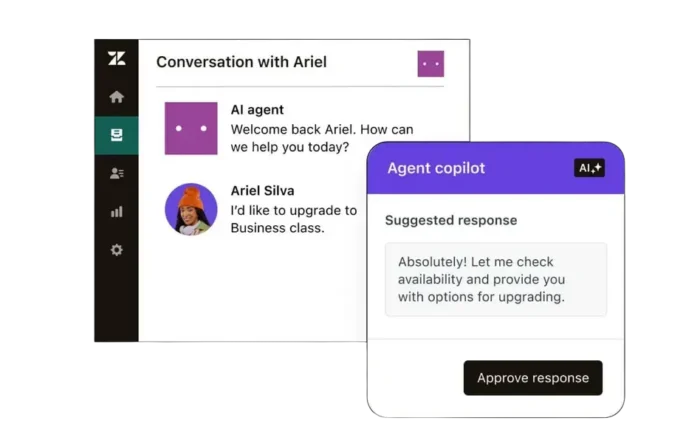
AI agents combine conversational capabilities with process logic. They identify intent, access connected systems through APIs and execute approved actions autonomously. Cases outside their defined permissions are handed over to people.
Example: An AI agent checks a return request, creates a shipping label and updates the case in the ecommerce system.
AI copilots
AI copilots support customer service agents with summaries, suggested replies and recommended next steps. The final decision remains with the agent.
Example: The copilot summarises a lengthy complaint and suggests a suitable reply and the next steps in the process.
Classification and intelligent routing
AI analyses incoming tickets by topic, language, sentiment and urgency and stores the results in ticket fields for prioritisation and routing. In Zendesk AI, intelligent triage handles some of these tasks.
Example: An urgent damage report is identified, prioritised and routed directly to the relevant specialist team.
Analytics, quality and capacity planning
AI analyses large volumes of service interactions, identifies quality issues and forecasts future request volumes. Zendesk QA can automatically evaluate customer interactions and systematically surface quality issues, while Zendesk WFM uses forecasting to support capacity and workforce planning.
Example: The system identifies recurring quality issues and predicts when additional staff will be needed.
Common use cases for AI in customer service
The technologies described above can be used across almost any service process. They are particularly useful where teams receive many similar requests, information needs to be brought together from different sources or agents regularly repeat the same steps.
Self-service and AI-powered answers
Customers receive immediate answers to recurring questions, regardless of customer service opening hours.
Typical cases: Opening hours, delivery options, return policies and status requests.
Automated ticket processing
Incoming tickets are automatically categorised, prioritised and routed to the appropriate team instead of entering an unsorted queue.
Typical cases: Complaints, technical incidents and urgent customer issues.
Support for customer service agents
Summaries, relevant knowledge and suggested replies are available immediately, while agents decide which recommendations to use.
Typical cases: Complex complaints, multilingual requests and onboarding new team members.
Process data and documents
AI extracts information from emails, PDFs, images or forms, checks it for completeness and writes it to ticket fields or connected systems.
Typical cases: Order numbers, invoice data and damage reports.
Automate backend processes
Customer requests can trigger actions in connected ecommerce, CRM or logistics systems without agents having to switch manually between applications.
Typical cases: Checking delivery status, creating return labels and preparing refunds.
Analyse quality, trends and capacity
Service interactions are evaluated systematically, helping teams identify quality issues and capacity bottlenecks earlier.
Typical cases: Quality reviews, request-volume forecasting and unusual ticket spikes.
AI-powered backend automation: from customer request to downstream workflow
When people think of AI in customer service, they often think mainly of chatbots or automated replies. However, a large – and, in our view, often the most useful – part of automation happens in the background. There, AI analyses incoming requests, structures data, enriches it with information from other systems and triggers the appropriate downstream workflows.
These workflows are channel-independent: requests can arrive by email, form, phone, messaging or API and then follow the same automated processing workflow.
- Analyse the request The system detects the topic, language, sentiment, urgency and relevant details.
- Structure the ticket and its data AI populates fields and adds order numbers, product data or contract information.
- Retrieve information from connected systems Required data is retrieved from CRM, ecommerce, ERP, logistics or other backend systems.
- Carry out approved actions AI triggers status checks, routing, refunds or other defined downstream workflows.
- Review the outcome and hand off If AI cannot or should not resolve the request, the responsible team receives all relevant data and context.
Requirements for implementing AI in customer service
Reliable AI in customer service depends on clearly scoped use cases, current data, defined processes, functioning system access and measurable quality standards.
Why data quality matters
AI systems can only work with the information they are allowed to access. Outdated help centre content, incomplete ticket data and inconsistently maintained fields can lead to inaccurate answers, incorrect classifications or faulty process steps.
A well-maintained knowledge base therefore provides an important foundation. Structured ticket data, unambiguous categories and binding rules for determining which sources are reliable are equally important.
Core requirements for implementation
-
Clear use case and measurable objective
Before implementing AI for customer service, teams should define which problem it needs to solve – such as reducing handling times, improving routing or automating recurring requests.
-
Current and structured data
Knowledge articles, ticket fields, categories and process data need to be complete, understandable and current. Conflicting sources should be resolved before AI is introduced.
-
Defined processes and responsibilities
AI needs clear rules specifying which steps it may automate, who reviews the results and which team is responsible for exceptions.
-
Suitable integrations and permissions
AI needs controlled access to relevant systems for status checks and downstream workflows. APIs, roles and write permissions must be configured correctly.
-
Clear handoffs and fallbacks
Teams need to define when a request is handed over to an agent and which information is provided with it. Reliable fallback processes are also required for system outages or missing data.
-
Monitoring and continuous optimisation
Response quality, automation rates, repeat contacts and incorrect routing should be evaluated regularly. Only this data shows whether AI is genuinely improving the service.
What data do AI systems need in customer service?
The sources required depend on the specific use case. AI systems often access several of the following types of data:
- Knowledge bases and help centres
- Support tickets and conversation histories
- Forms, fields and categories
- CRM and customer data
- Product and order data
- Macros and process rules
- Quality and performance data
Not every AI application needs access to all available data. Permissions should be limited to the specific purpose. This reduces potential sources of error and makes privacy-compliant implementation easier.